The Hard Truth: You Don't Have a Traffic Problem
Let’s be blunt: Most ecommerce founders aren’t suffering from a bad product. They’re suffering from a leaky bucket.
You can have a world-class product, competitive pricing, and a flood of high-quality traffic—but if your product page only informs instead of converts, you’re just donating money to ad platforms. The gap between a "browsing" visitor and a "paying" customer is huge, and most pages fail to bridge it.
According to Baymard Institute, the average ecommerce conversion rate hovers between 2.5% and 3%. Meanwhile, top-tier stores consistently hit 5% or higher. The difference isn't usually the inventory; it’s the presentation.
If your page isn’t strategically engineered to move a user from curiosity to checkout, you are leaving revenue on the table every single hour.
Stop Building "Digital Brochures"
Scroll through a typical Shopify or WooCommerce store, and you’ll see the same generic template: A stock image, a dry title, a price tag, and a wall of technical text.
This layout assumes the customer is already sold. In reality, modern shoppers are skeptical, easily distracted, and constantly tab-switching. Nielsen Norman Group research confirms that users don't read web pages—they scan them for survival signals.
If your page doesn’t answer "What’s in it for me?" within the first three seconds, they’re gone.
The 5 Pillars of a High-Converting Product Page
1. Radical Clarity Above the Fold
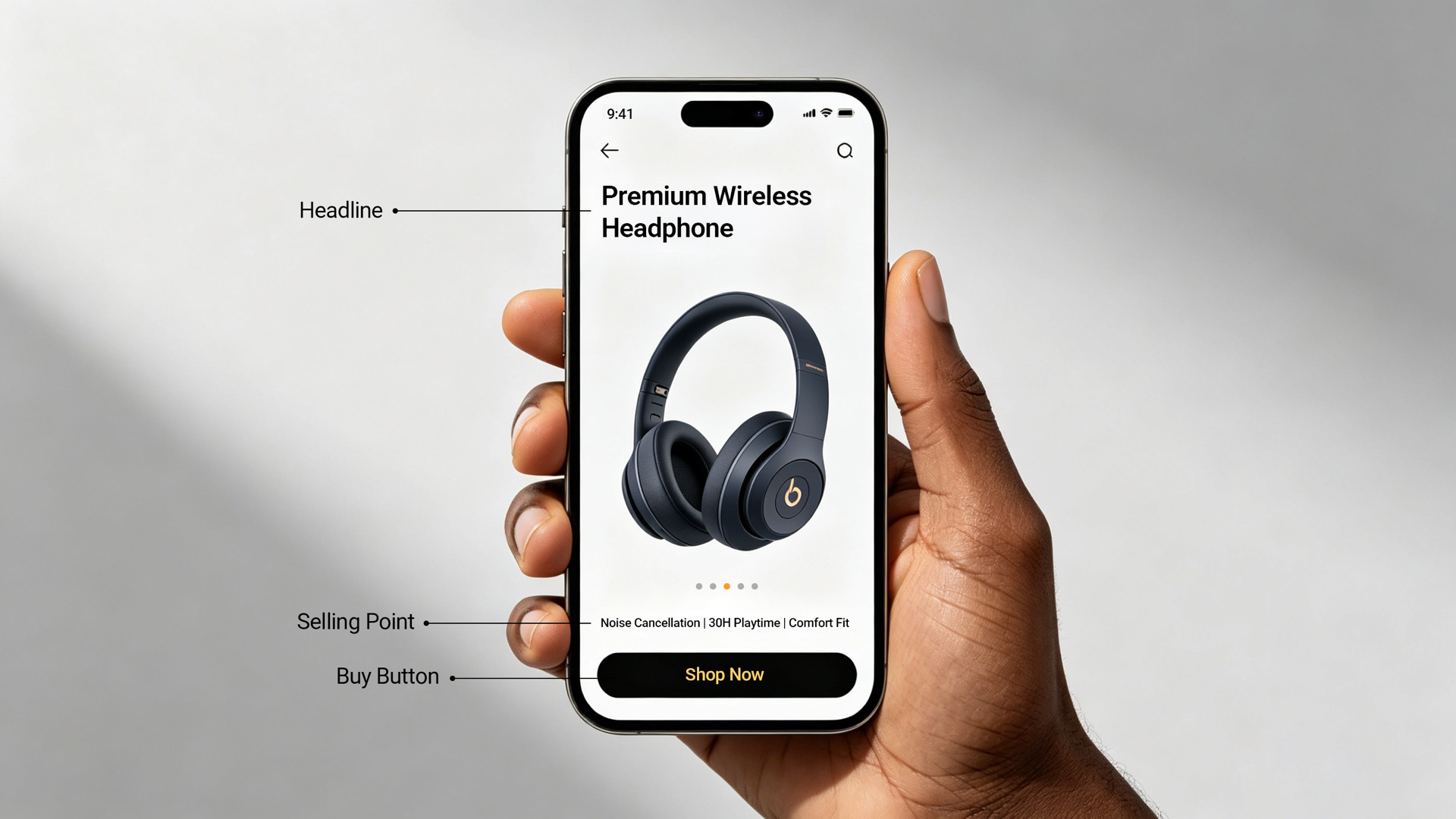
The "Fold" is your high-stakes real estate. Before a user even thinks about scrolling, they must understand:
- What exactly is this?
- Who is this for?
- Why is this better than the alternative?
Data from CXL shows that Clarity consistently outperforms "clever" copywriting. If a user has to do mental gymnastics to understand your value proposition, the friction will kill the sale.
2. Sell the "After," Not the “Specs”
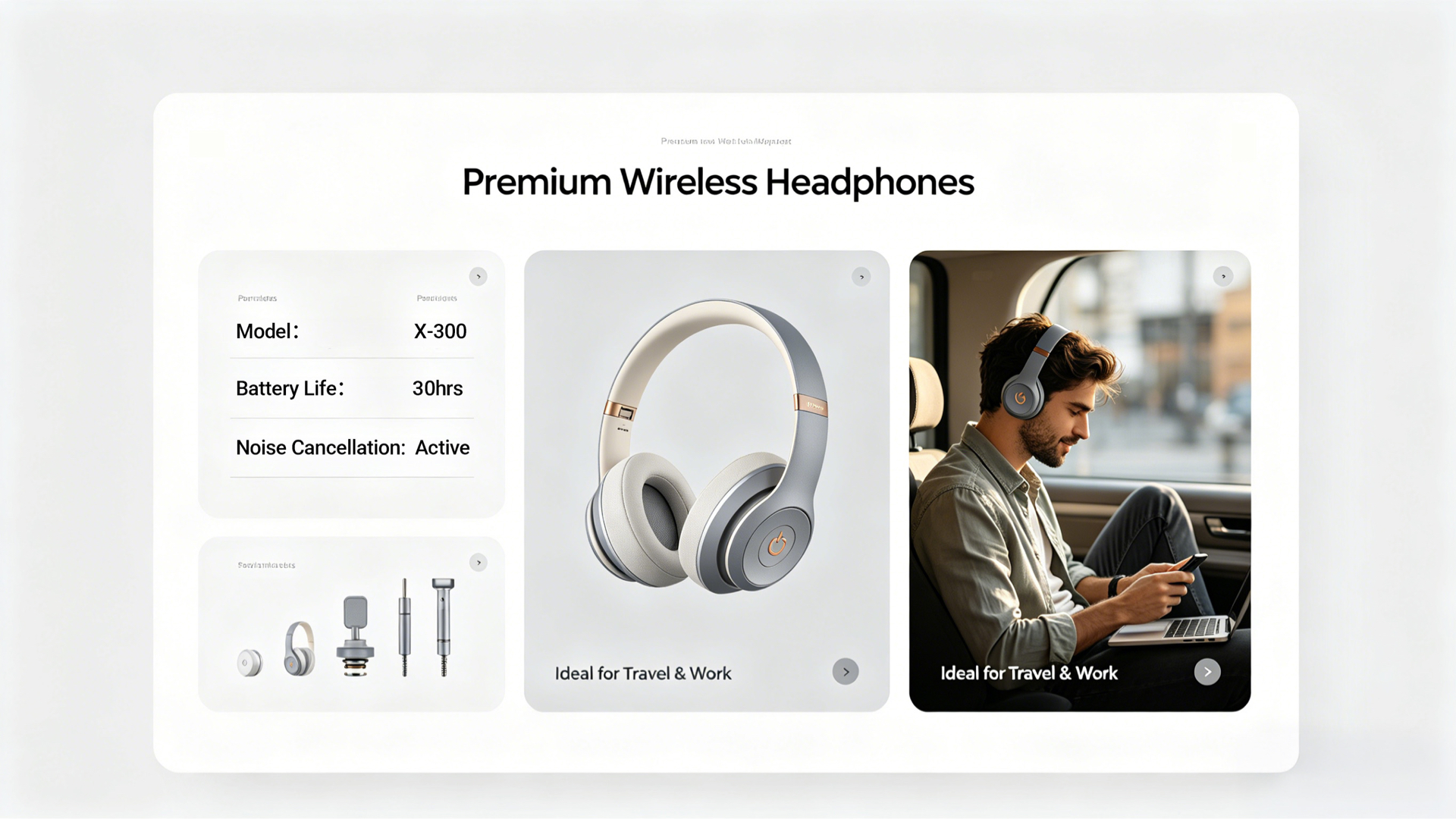
Features describe the product; benefits justify the investment. Instead of listing dry specifications, translate them into human outcomes.
- Feature: "5000mAh Battery" $\rightarrow$ Benefit: "Forget your charger at home for the entire weekend."
- Feature: "Waterproof IPX7" $\rightarrow$ Benefit: "Safe to use in the shower or during a heavy downpour."
HubSpot reports that benefit-driven messaging aligns more closely with user intent, reducing the cognitive load required to make a purchase decision.
3. Visual Proof Over Marketing Claims

In 2026, a static photo isn't enough. High-velocity stores use a "Visual First" strategy to build instant trust:
- Contextual Imagery: The product in a real-world setting.
- Short-form Demo Videos: Showing the product in motion.
- UGC (User-Generated Content): Raw, unpolished proof that real people use this.
According to Shopify, adding video to a product page can boost conversion rates by up to 80%. It bridges the "touch-and-feel" gap that ecommerce naturally creates.
4. Strategic Social Proof
Generic reviews like "Great product!" are useless. You need "Outcome-Driven" social proof that addresses specific objections. Look for reviews that mention:
- The specific problem the customer had before.
- How easy it was to set up or use.
- The exact moment they realized it was worth the money.
Research from the Spiegel Research Center highlights that displaying quality reviews can increase conversion rates by a staggering 270%.
5. Eliminating the "Hidden Friction"

Even a motivated buyer can be stopped by a tiny doubt. Baymard Institute reports that nearly 70% of carts are abandoned, often due to "friction points" like unexpected shipping costs or confusing return policies.
Make the logistics invisible: Surface your shipping times, return guarantees, and secure payment icons right next to the "Add to Cart" button.
Your Optimization Checklist
Don't redesign your whole site. Focus on these high-impact pivots:
- Audit the Headline: Is it a product name, or a promise?
- The "So What?" Test: Read every sentence in your description. If it doesn't answer "So what?", delete it.
- Upgrade the Assets: Swap your supplier's white-background photos for lifestyle shots.
- Reorder the Flow: Move your best testimonial and "How it Works" section higher up the page.
Where Genstore Changes the Game
Most founders guess. They pick a product and hope a generic page works. Genstore flips the script by integrating product selection with Conversion Logic.
Instead of just finding a "winning product," Genstore helps you identify the winning angle—matching high-demand signals with the specific psychological triggers that make a page convert. Because in the modern market, a great product and a great page aren't two different things—they are a single, unified system.
Final Takeaway: If your sales are stalling, don't just throw more money at ads. Fix the destination. When your page makes the decision feel "obvious" to the customer, your business stops being a gamble and starts becoming a machine.