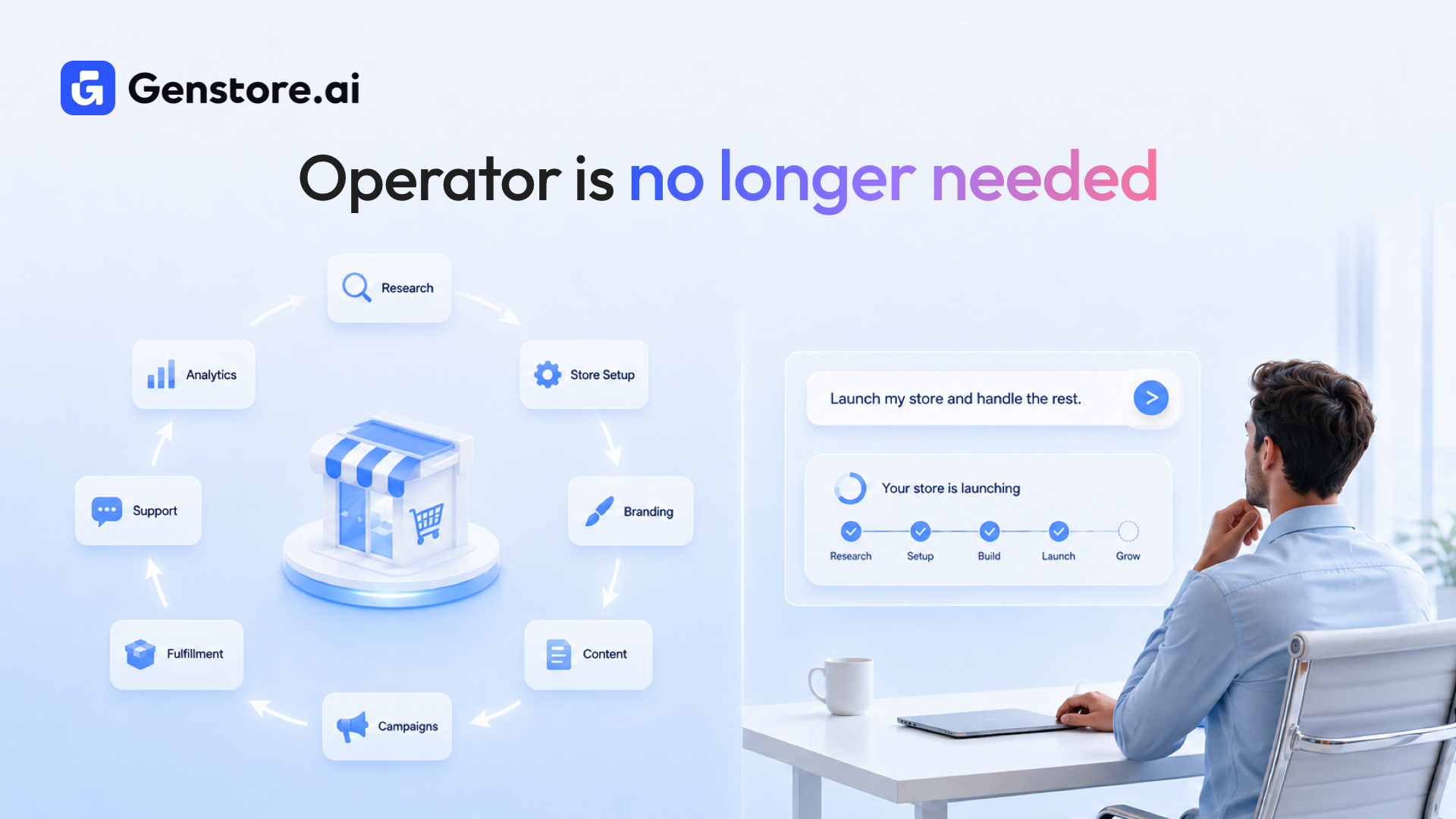
For the past decade, scaling an ecommerce business followed a linear, painful law: Growth requires headcount.
More products meant more sourcing agents. More traffic meant more media buyers. More orders meant a growing backend army to coordinate fulfillment and support. Even platforms like Shopify, while revolutionary, didn't actually remove this complexity—they simply standardized the mess into an "app for everything" ecosystem.
As we move through 2026, that model hasn't just aged; it has broken. The fastest-growing brands are no longer hiring operators. They are removing the need for operators entirely.
The Real Shift: Ecommerce Is Becoming Agent-Mediated
A fundamental new layer has formed between the brand and the consumer: AI Agents. We are moving away from a world where humans browse, compare, and click, toward a world where agents execute on behalf of intent.
According to Deloitte, we have entered the era of agentic commerce, where AI systems complete multi-step shopping journeys end-to-end. McKinsey reinforces this, noting that shopping is shifting toward intent-driven flows where agents handle the evaluation, negotiation, and execution.
In this landscape, the traditional "operator" who manually uploads CSVs, tweaks bid prices, and manages customer tickets is a bottleneck. At Genstore, we see the store not as a destination for humans, but as a data-rich environment optimized for agentic discovery.
Why Operators Existed: Structural Fragmentation, Not Strategic Need
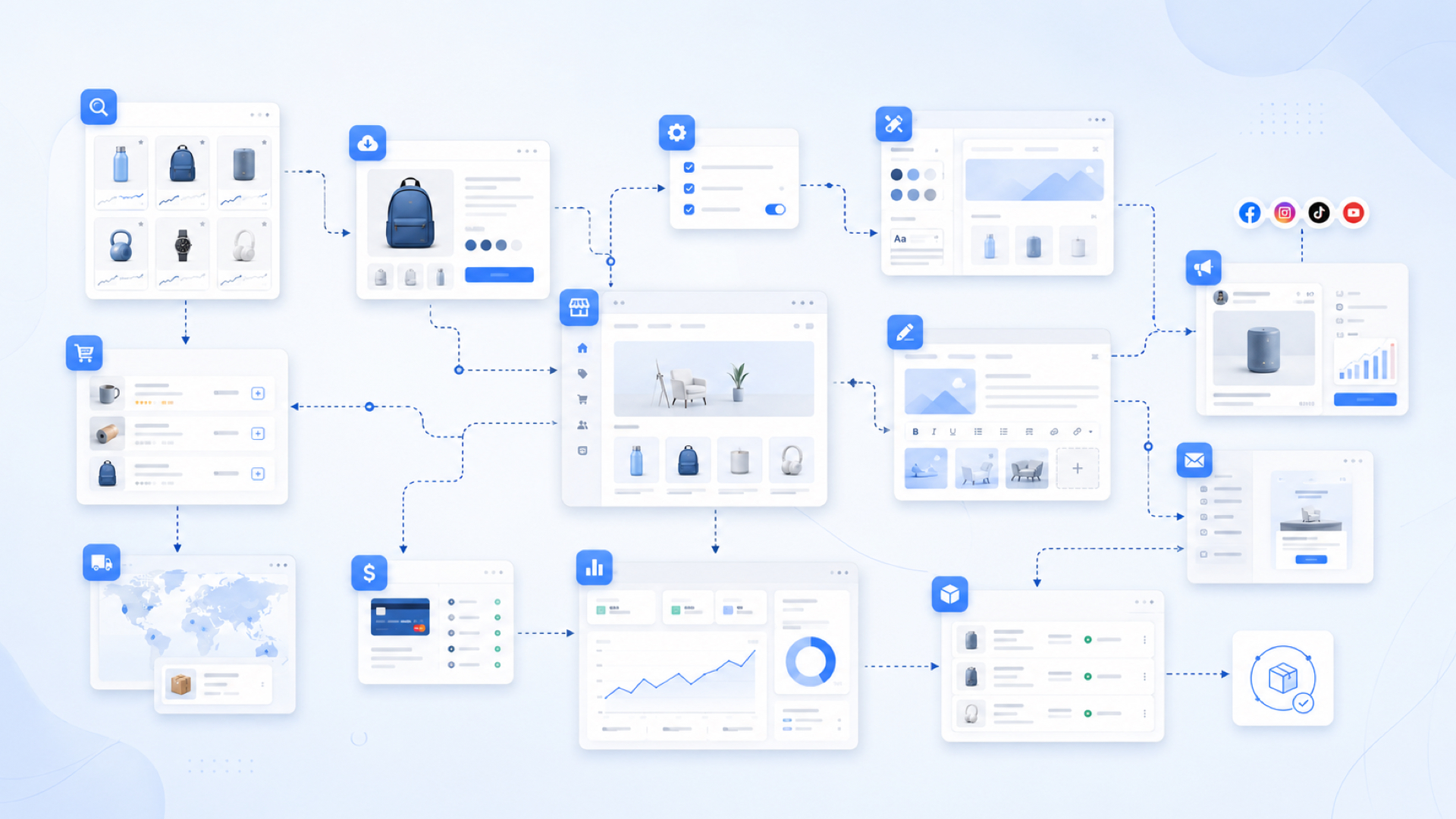
The "operator" was never a strategic role; it was a structural patch for fragmented systems. Until now, ecommerce lived in silos:
- Discovery platforms (Social/Search)
- Supplier networks
- Storefront builders
- Analytics dashboards
Humans were the "glue" connecting these disconnected signals. Research shows that while over 70% of retailers are experimenting with AI, only a tiny fraction have achieved a fully unified system.
The bottleneck isn't a lack of talent—it's system fragmentation.
AI-Native Commerce: Beyond Automation to Consolidation
The Genstore philosophy isn't about "automating" your Shopify tasks. It’s about AI-Native Consolidation. True efficiency happens when product research, store creation, content generation, and ad iteration merge into a single execution loop. We are seeing real-world deployments where AI agents handle product catalogs and pricing logic autonomously. Even in the complex world of customer support, structured agent systems are replacing the "chat-bot" of 2024 with full-service resolution engines.
While Shopify provides the infrastructure, it still requires you to be the architect, the plumber, and the electrician. Genstore is the execution.
The Rise of Agentic Traffic
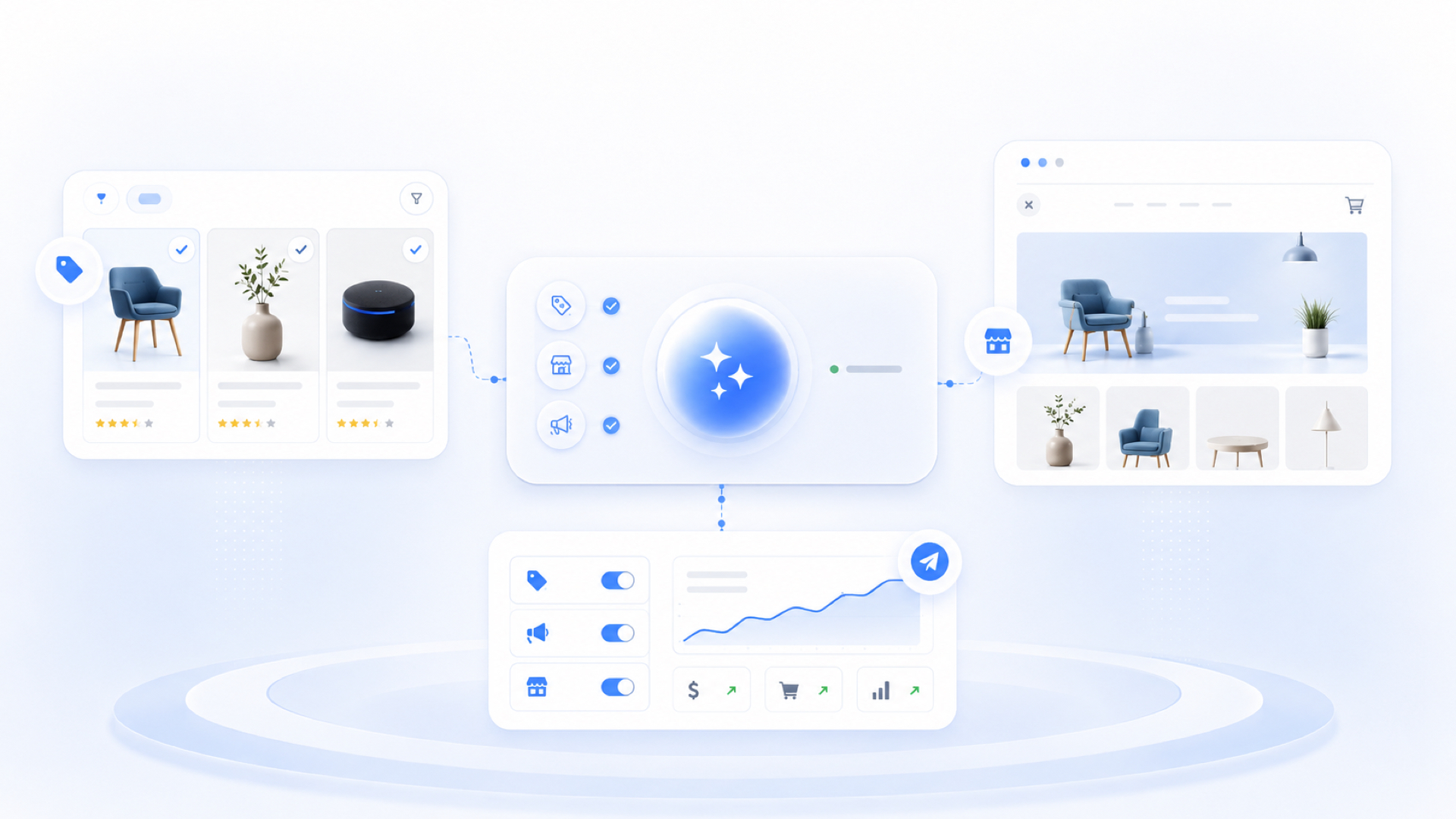
Perhaps the most jarring shift in 2026 is where your customers come from. "Agentic traffic"—traffic generated by AI agents searching for products—is the fastest-growing segment of the web, reportedly increasing nearly 8,000% year-over-year.
This traffic behaves differently:
- It does not "scroll" through a feed.
- It does not care about "lifestyle" branding that doesn't map to data.
- It filters options down to a winner-takes-most set of 4–6 products.
Visibility is no longer about "Page 1 of Google." It is about being the preferred choice of an algorithmic decision system. If your store isn't AI-native, you are invisible to the most efficient buyers on the planet.
The One-Person Company: Small Teams, Infinite Scale
When execution costs collapse, the "One-Person Business" becomes the default. We are seeing a surge of builders on Reddit and other dev communities launching fully automated pipelines where SEO, ingestion, and updates happen via API.
At Genstore, we enable a single individual to:
- Launch multi-niche stores without multiplying their workload.
- Test 100+ creative angles simultaneously.
- Iterate at the speed of data, not the speed of an agency's weekly meeting.
The New Bottleneck: Decision Quality
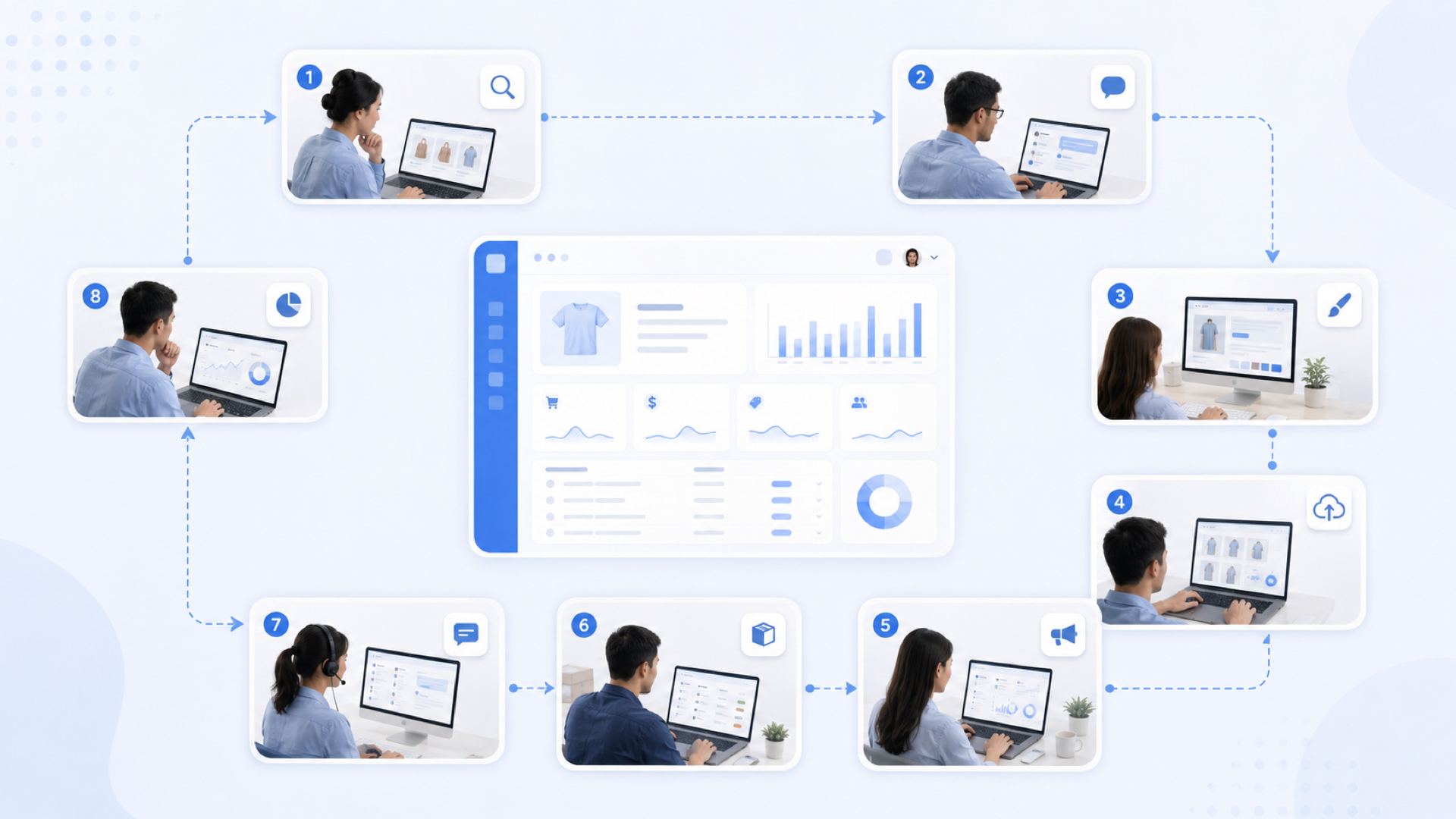
If execution is cheap and automated, where is the value? It has moved upstream.
Recent studies on agentic preferences show that AI systems are highly sensitive to how listings are structured and how data is presented. The human role has shifted from "doing the work" to "setting the direction."
The critical questions are no longer "How do I set up a Facebook Pixel?" but:
- Which niche actually shows a demand signal?
- What product angle will resonate with this specific agentic filter?
- Which direction should the system pivot to next?
Conclusion: From Tools to Intent
The transition is simple: We are moving from tool-operated commerce to intent-executed commerce. In the old world, you operated software to get a result. In the Genstore world, you define the goal, and the system executes. The era of the "Ecommerce Operator" is over. The era of the AI Strategist has begun.
The question is no longer how you run your business. The question is: What should your system do next?